
Enterprise Architecture as an AI Enabler
Why Successful AI Adoption Requires a Clear Enterprise Architecture
Artificial intelligence is no longer limited to research projects and isolated pilot initiatives. More and more companies want to integrate AI models into their processes, make internal data usable, and develop concrete applications that generate measurable business value. However, it often becomes clear that the real challenge is not simply selecting a powerful AI model. The much greater challenge is integrating that model meaningfully into the existing organization and IT landscape.
This is exactly where the role of the Forward Deployed Engineer (FDE) is becoming increasingly important.
The growing importance of the Forward Deployed Engineer role, particularly in the implementation of AI solutions, can be seen, for example, at OpenAI. In 2026, the company established a dedicated unit called the OpenAI Deployment Company, in which Forward Deployed Engineers work directly with companies on developing and deploying AI systems in production. Forward Deployed Engineers are expected to work with strategically important customers on complex AI solutions, from the initial requirements analysis and system design through to production deployment. Anthropic is also increasingly working with partner companies to deploy Forward Deployed Engineers directly within customer organizations, where they integrate AI solutions into existing systems.
What does a Forward Deployed Engineer do?
A Forward Deployed Engineer works at the intersection of technology, business functions, and the customer. The role extends traditional software engineering tasks by adding a strong business and organizational context. Before a specific solution can be developed, the engineer must understand which problem the company wants to solve, how the existing IT landscape is structured, and which technical, organizational, and regulatory conditions must be taken into account when implementing the solution.
Typical responsibilities include, for example:
-
analysis of business processes and business requirements
-
identification of suitable AI use cases
-
technical design of the solution
-
integration of existing data sources and applications
-
development of custom integrations
-
deployment of the solution into production
-
close coordination with business departments, IT, data protection, and management
A Forward Deployed Engineer therefore combines traditional engineering tasks with system design, technical consulting, and close coordination between the teams involved.
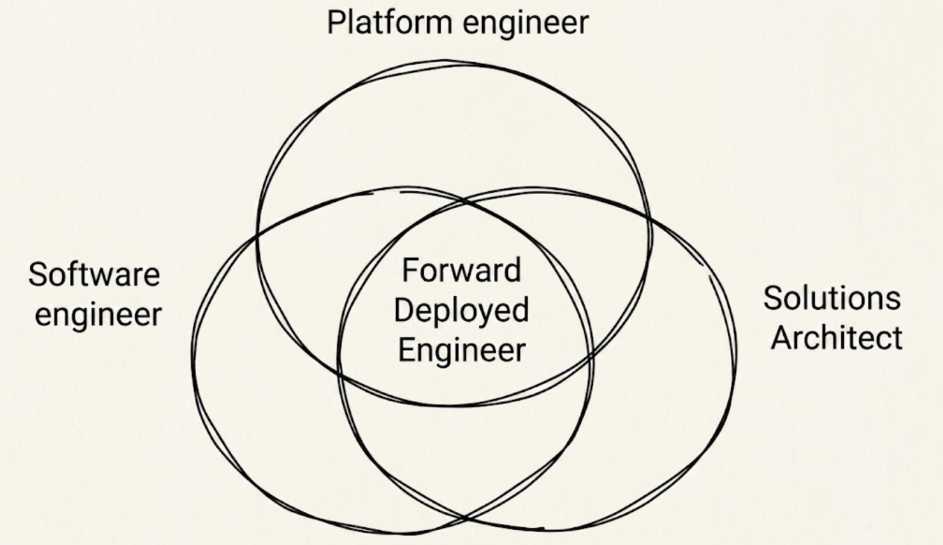
The role is not simply about providing a company with an AI model. A Forward Deployed Engineer must ensure that a technological opportunity becomes a functioning solution in a real-world enterprise environment.
This is where an important lever emerges. The more transparent the existing enterprise architecture is, the less time needs to be spent rediscovering it for every new AI project.
The real problem is often not the AI
In many companies, the IT landscape has evolved over years or even decades. New applications have been introduced, existing systems extended, interfaces added, and temporary solutions created. Some systems are very well documented, while others are only partially documented. Knowledge about certain dependencies sometimes exists only in the minds of individual employees.
This leads to typical questions such as:
-
Which applications contain the required data?
-
Which interfaces already exist?
-
Which systems access this data?
-
Who is responsible for an application or process?
-
Which security requirements need to be considered?
-
What impact would a technical change have on other systems?
-
Which technologies are permitted?
-
Are there already similar solutions within the company?
If reliable answers are missing, a Forward Deployed Engineer first has to spend a significant amount of time understanding the existing landscape.
The AI use case then does not begin with the actual development work, but with an extensive discovery journey through applications, databases, interfaces, processes, responsibilities, and technical legacy issues.
A company without an architecture overview is like a building without a blueprint
A fitting analogy is a large building that has repeatedly been renovated and extended over many years.
New rooms have been added, walls moved, additional electrical wiring installed, and water pipes added later. Some changes were carefully documented, while others were implemented only as temporary solutions. Certain lines now run through places that no one knows precisely anymore.
Now the building is to be modernized. For example, a new elevator is to be installed.
In principle, this is possible. But before the work can begin, the project team first has to determine:
-
Which walls are load-bearing?
-
Where do the electrical, water, and data lines run?
-
Which areas of the building will be affected by the work?
-
Which regulations must be complied with?
-
Which other modernization measures are taking place in parallel?
-
What consequences would an intervention at a specific point have?
Without reliable construction and utility plans, the team can still begin the work. However, it has to proceed more carefully, conduct more investigations, and expect unexpected problems. In the worst case, a line is damaged during the work whose existence no one was aware of.
The situation is similar when introducing AI into a complex enterprise landscape.
Enterprise Architecture provides a shared point of orientation
The Forward Deployed Engineer would not become unnecessary in the analogy above. However, Enterprise Architecture provides the required blueprints, inventory information, and dependency analyses. Enterprise Architecture describes the key relationships and dependencies between a company’s business architecture, processes, data, applications, and technological infrastructure. These are exactly the kinds of information a Forward Deployed Engineer needs.
How Enterprise Architecture improves the work of an FDE
1. Faster analysis of the current situation
If applications, processes, data sources, and interfaces are already documented, the Forward Deployed Engineer can understand more quickly where the planned AI solution needs to be integrated.
Instead of first conducting numerous discussions and gathering information from different documents, the engineer receives a structured overview of the relevant environment.
2. Early identification of dependencies
An AI application often accesses multiple systems and data sources. Changes to one interface can therefore affect other applications and processes.
Enterprise Architecture makes it possible to identify such dependencies at an early stage. Architecture methods are used, among other things, to assess the complexity, feasibility, cost, impact, and dependencies of strategic changes.
3. Better selection of suitable use cases
Not every technically feasible AI use case also makes sense from a business or organizational perspective.
By linking business processes, business capabilities, and applications, companies can examine where meaningful value can actually be created. This helps prevent AI from being introduced simply because the technology is available.
4. Consideration of existing standards
An established Enterprise Architecture often also includes technology and architecture standards. This makes it possible to determine early on which platforms, interfaces, cloud services, or security mechanisms are permitted.
The Forward Deployed Engineer therefore does not develop the solution in isolation from the rest of the IT landscape, but within a defined and transparent framework.
5. Reusable knowledge for future projects
Without Enterprise Architecture, knowledge collected for a project is often documented only within that specific project. With the next initiative, the analysis starts all over again.
A central architecture foundation, by contrast, ensures that the information gathered remains permanently available. This benefits not only AI projects, but also cloud migrations, software implementations, modernization initiatives, mergers, and regulatory changes.
Conclusion
Introducing AI into companies is not only a question of choosing the right model. An AI solution must access existing data, communicate with existing applications, take organizational requirements into account, and integrate into an IT landscape that has often grown complex over time. These conditions are exactly what make many AI projects demanding.
Forward Deployed Engineers play an important role because they connect technological possibilities with the actual enterprise environment. Enterprise Architecture does not replace this work. However, it can significantly improve the conditions under which it is carried out.
If applications, interfaces, data, technologies, responsibilities, and dependencies are already documented transparently, this knowledge does not have to be painstakingly gathered again for every AI project. The potential impact of a new solution can be identified earlier, integration options can be assessed more quickly, and existing standards can be considered from the outset.
Enterprise Architecture can therefore become an important enabler for the introduction of AI. It does not reduce the complexity of the technology itself, but it makes the environment in which that technology is to be used much easier to manage.
This benefits more than just Forward Deployed Engineers. Companies create a reusable foundation that allows additional AI use cases to be implemented faster and in a more structured way. Instead of having to rediscover their own IT landscape at the beginning of every new initiative, project teams can focus earlier on the real question: How can AI be integrated meaningfully into the company and used successfully in production?
Or, returning to the building analogy: The blueprint does not install the new elevator. But it makes planning and installing it considerably easier.

Kai Herings
Senior consultant
Optimize alignment between IT and business with expert advice and clear strategies.
